


Pants Guide
What Are Chino Pants
Chino pants are casual trousers traditionally made from cotton twill, a woven fabric with fine diagonal ribs. A conventional pair has slanted front pockets, narrow back-pocket openings, belt loops, and a fly. They are worn casually and in many business-casual settings. Modern chino ranges include stretch fabrics, synthetic materials, and cuts extending from slim legs to roomy, pleated shapes.
The easiest way to picture a conventional pair is to think of trousers with a relatively clean outer surface. The front pockets usually disappear into the side of the garment instead of sitting on top of the fabric. At the back, the pocket openings are commonly finished as narrow horizontal welts.
The word chino can refer to the fabric as well as the trousers made from it.

What Chino Fabric Actually Looks Like
Look closely at the fabric around a pocket edge or inside a turned-up hem. Fine diagonal lines should be visible on many traditional chinos. Those lines come from the twill weave.
During weaving, the crossing point between the lengthwise and crosswise yarns shifts as each row is formed. That repeated shift creates the diagonal surface associated with twill. Denim is also a twill, which is one reason fabric weave alone cannot tell you whether a pair of trousers is chinos or jeans.

Traditional chino cloth is usually made from cotton yarn. A dense, fine twill can look almost smooth from normal viewing distance, especially after washing or surface finishing.
Fabric weight changes how much material is present in a given area. A cloth listed at 250 GSM contains 250 grams of fabric per square meter. That figure is useful when comparing two products made with similar constructions, although it does not give a direct answer for softness, stretch, or airflow. Those properties also depend on yarns, weave density, finishing, and fiber content.
Stretch chinos commonly add a small amount of elastane. Levi's XX Chino Standard Taper, for example, is listed in a 98% cotton and 2% elastane stretch twill. The elastane percentage is the fiber content rather than a measurement of how far the finished cloth stretches.
The Pockets Are One Of The Fastest Clues
A conventional chino usually has diagonal or slightly curved front pocket openings beginning near the waistband. Your hand enters the pocket from the side, and the pocket bag hangs behind the outer fabric.
At the back, welt pockets are common. A welt pocket looks like a narrow horizontal opening rather than a patch sewn visibly onto the seat. Buttons may be added to keep the pockets closed.

This construction leaves most of the hips and thighs visually clean. You do not normally see the large exterior thigh pockets associated with cargo pants.
Modern designs sometimes change the formula. Five-pocket chinos use a layout closer to jeans, including rear patch pockets. Performance styles may add concealed zipper compartments without changing the basic chino silhouette.
Are Chinos And Khakis The Same Thing?
The two words overlap, which is why clothing stores do not use them consistently.
Khaki originally refers to a dusty yellow-brown color and has a long association with military clothing. In American clothing language, khakis also became a common name for casual trousers. Chino developed as a name for the cloth and the trousers produced from it.
That history creates an obvious overlap: a pair of tan cotton-twill chinos can quite naturally be called khakis.
Color is where the distinction becomes clearer in everyday shopping. Navy chinos, black chinos, olive chinos, and gray chinos are all normal product descriptions. Calling a black pair “khaki” makes much less sense when khaki is being used as a color name.
For that reason, the product name alone is a weak way to judge construction. Look at the listed fabric, pocket layout, rise, and leg shape.
Chinos Are Not Defined By A Slim Fit
The slim, flat-front chino became especially common in modern casual and office clothing, but it is only one version of the garment.
A tapered pair has more width higher on the leg and becomes narrower toward the ankle. Levi's gives a useful real measurement on its XX Chino Standard Taper. In reference size 32, the company lists a 17-inch knee circumference and a 13-inch leg opening, with a 10¾-inch front rise. The lower leg therefore loses four inches of circumference between the knee and hem.
The upper part of a tapered chino does not need to be tight. Straight chinos carry more of their width toward the hem. Relaxed cuts add space through the seat and thighs. Wide-leg chinos take that volume farther down the leg.
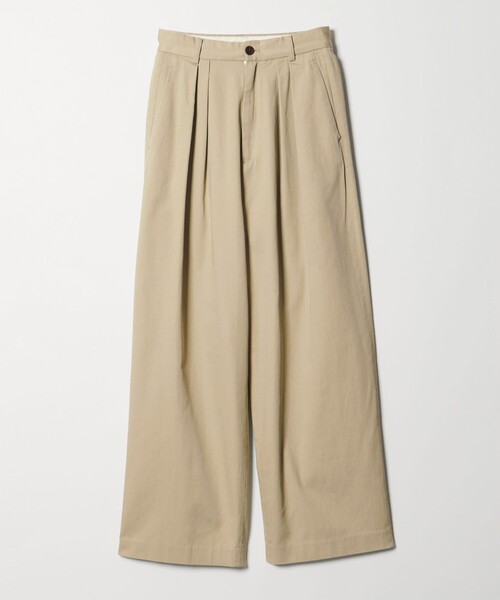
Pleats are folds built into the trousers below the waistband and provide additional fabric through the upper section. They have appeared on chinos for decades and are not reserved for formal dress trousers.
Rise changes the proportions again. A higher rise places the waistband farther up the body and changes the amount of fabric running through the crotch and seat. Low- and mid-rise versions sit farther down.
What Makes Chinos Different From Jeans?
The difference is easier to understand when you look beyond the fact that both can use cotton twill.
Traditional jeans normally use denim with indigo-dyed lengthwise yarns and lighter crosswise yarns. Their construction commonly includes visible rear patch pockets, a small coin pocket at the front, rivets at stress points, and a shaped yoke below the back waistband.
A conventional chino is visually quieter. The rear pockets are commonly set into the garment as welts. Rivets are usually absent. The front pockets enter from the side instead of using the familiar curved five-pocket-jeans opening.
Five-pocket chinos deliberately blur this distinction. They take the pocket layout associated with jeans and use it on chino-style cotton twill. In that case, the product specification and fabric become more useful than one isolated construction detail.
Chinos And Cargo Pants Can Use Similar Fabric
Cotton twill appears frequently in both categories.
The difference becomes obvious around the thigh. Cargo pants are built around additional storage pockets attached to the legs. A traditional cargo pocket has enough depth to hold more than a normal trouser pocket and may include a flap, pleat, snap, zipper, or bellows construction.

Chinos usually leave this part of the trouser leg clear.
That clean thigh area is one reason chinos work easily with tucked shirts, sweaters, polos, jackets, and other pieces that would compete visually with large cargo pockets.
Where Dress Pants Enter The Picture
There is no single fabric that defines all dress pants. Wool, wool blends, polyester blends, cotton, and other materials appear in the category. Chinos can move into a dressier wardrobe when their finish and cut suit the setting.
A smooth cotton chino with a tidy hem, pressed crease, and clean waistband can work in many business-casual offices. A heavily washed pair with visible fading and a loose cropped leg reads much more casually.

For an office outfit, navy straight-leg chinos can work with a pale blue button-down shirt and leather loafers. A fine-gauge sweater fits over the shirt in cooler weather. When a workplace expects a full suit, matching suit trousers are the appropriate garment.
What Modern Chinos Can Be Made From
Cotton still dominates the familiar chino category, although the name is now used more broadly.
Performance trousers show how far the materials have moved. Some modern chinos use polyester-rich cloth engineered for stretch, moisture handling, quicker drying, or wrinkle resistance while retaining slanted front pockets and discreet rear pockets.
This matters when shopping online because “chino” no longer guarantees a cotton garment.
100% cotton gives you a fabric without elastane added for stretch.
Cotton with elastane introduces stretch yarns into the fabric construction.
Polyester-rich performance fabric can be engineered for different drying, wrinkle, and movement properties.
The fiber-content label gives the actual percentages for the garment you are considering.
Washing And Finishing Change The Feel Of Cotton Chinos
Two cotton chinos with similar fiber content can feel quite different when new.
Garment washing softens cloth after construction. Garment dyeing colors the trousers after they have been sewn, and small variations in shade can develop between garments. Peaching creates a fine soft nap at the surface, producing a slightly velvety hand.
Enzyme finishing can alter the surface of cotton as well. During cellulase biopolishing, enzymes act on microscopic fibers protruding from cellulose-based cloth. Removing those microfibrils produces a cleaner surface with less fuzz and can improve pilling performance.
This is why a substantial cotton chino does not automatically feel stiff. The fabric may already have gone through several softening or surface-finishing stages before reaching the store.
How To Read Chino Measurements
Do not rely on the size number alone when comparing brands. A nominal waist size can differ from the finished waistband measurement, and retailers do not all use identical garment specifications.
If a pair you already own fits well, measure that garment and compare the numbers with the new product.
| Measurement | How To Measure It |
|---|---|
| Waist | Button the trousers, close the fly, align the waistband, and measure straight across the top. |
| Hip | Measure straight across 7 inches below the top of the waistband. |
| Thigh | Measure 1 inch below the bottom of the crotch, perpendicular to the inseam. |
| Knee | Find the midpoint of the inseam, move 2 inches toward the crotch, and measure across the leg. |
| Inseam | Follow the inside seam from the crotch to the hem. |
| Leg opening | Flatten the bottom of the leg and measure straight across the hem. |
| Rise | Measure along the center seam between the crotch and the top of the waistband. |
The measuring position matters. For a 32-inch inseam, the halfway point is 16 inches below the crotch. A knee measurement taken 2 inches above that midpoint is therefore taken 14 inches below the crotch.

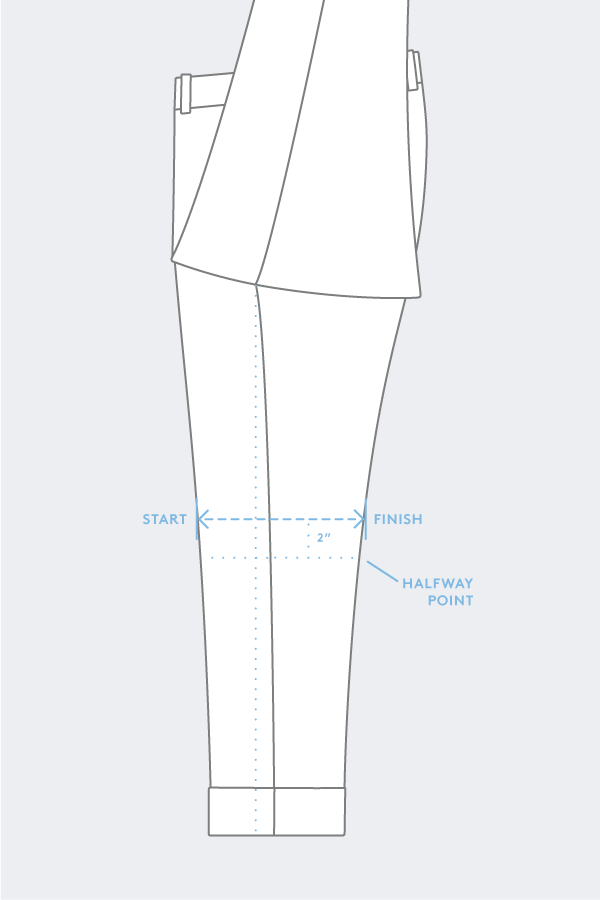
Pay attention to whether a retailer reports a flat width or a circumference. A flat leg opening of 8 inches represents approximately 16 inches around the hem.
What A Good Chino Fit Looks Like
Start around the hips because several fit problems become visible there.
With your hands out of the pockets, the openings should sit reasonably close to the body. Pronounced pocket flare combined with horizontal tension lines can indicate that the trousers need more room through the hips or seat. A small amount of pocket opening can occur because of body shape, so look at the surrounding fabric and how the trousers feel instead of judging from the pocket alone.
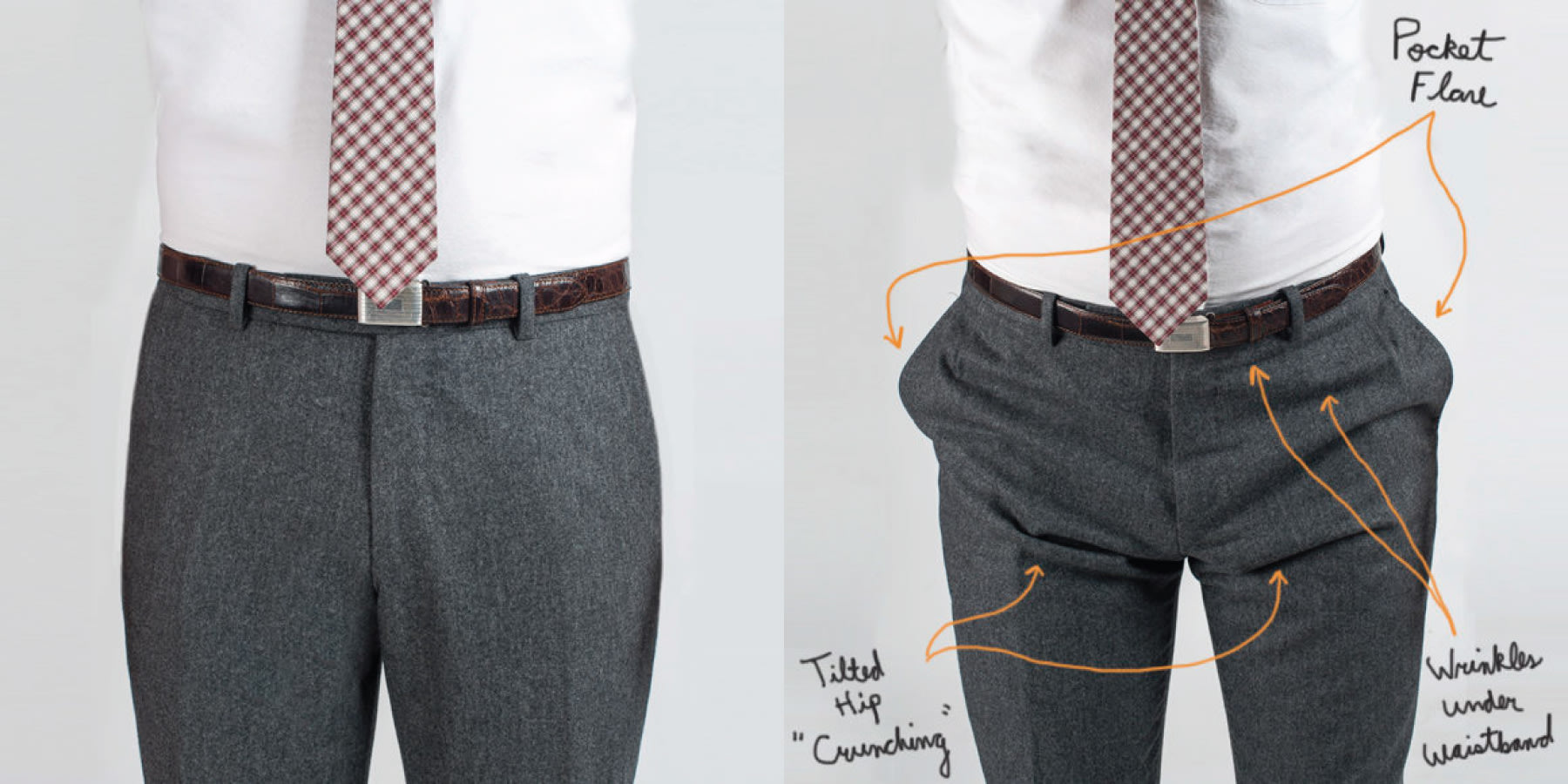
Sit down with the waistband at the height where you normally wear it. Pressure through the crotch may point to the rise or upper fit. Tightness across the thighs becomes easier to notice once the knees bend.
If you normally tuck in a shirt, wear one during the fitting. The additional layer occupies space inside the waistband.
Now stand and walk for a few steps. When fabric repeatedly catches around the calves and stays bunched there, check the knee width and leg opening. A tapered chino can have plenty of room at the thigh while becoming restrictive farther down.
Choose The Hem With Your Shoes On
The shoe changes where a trouser leg settles.
When the hem touches the top of the shoe and forms a fold, that fold is called a break. Some chinos are worn with only a small break. Cropped versions finish above the shoe and expose more ankle. Fuller trousers can carry extra length without producing the same appearance as a narrow tapered leg.

Wear the shoes you expect to use before marking a hem alteration. Walk around and sit down once before deciding. A cropped pair can rise noticeably when the knee bends, especially if the leg opening is narrow.
Permanent shortening is best done after a washable cotton pair has gone through the laundering method you plan to use.
How Much Can Chinos Shrink?
There is no useful single shrinkage percentage for all chinos. Cotton preparation, garment washing, finishing, dryer temperature, and fabric construction affect dimensional change.
Measure the actual garment if length matters.
Suppose an inseam is 80 cm before the first wash and measures 78.4 cm after the trousers have been washed according to the label and dried completely. The length reduction is 1.6 cm.
(80 − 78.4) ÷ 80 × 100 = 2%
That calculation describes the change in that measured direction. Record the waistband separately if you also want to track changes around the waist.
Machine-washing instructions vary by fabric. Performance chinos made from synthetic fibers may have very different drying and ironing requirements from garment-dyed cotton versions, so the sewn-in care label should determine the actual wash temperature, drying method, and ironing setting.