

Field notes
What Is Vintage Americana Fashion?

Vintage Americana is a way of dressing built out of second-hand American workwear: denim, chore coats, flannel, western shirts, varsity jackets, military surplus, souvenir tees. Every one of those started as a uniform for a particular American job. The outfit puts three or four of them on at once and reads as none of the jobs.
The clothes have to be old. No other style makes that demand. The year a garment was made is recorded on the garment itself, in the care label, the stitch type, the registration number and the union tag.
How to Put the Outfit Together
Start from the bottom. Denim decides everything above it. A straight or slightly tapered five-pocket in mid to dark indigo, sitting at the natural waist. A rigid 501 takes about six months of regular wear to break in, and feels aggressive for the first week. Vintage rises sit above the hip bone. Wearing them low is the single thing that makes old jeans read as costume.
Length has two workable settings and a third that reads as borrowed. Roll the hem into a one-inch cuff, or wear them at the length where they break slightly on the shoe. Straight-leg denim puddling at the ankle reads as borrowed.
One item on top does the work and the rest stays plain. A chore coat over a white tee. A flannel over a Champion sweatshirt. A wool varsity jacket with leather sleeves over a collared shirt. Two loud pieces at once reads as fancy dress, and a souvenir tee with a cracked print counts as loud. Boots or canvas sneakers underneath, in leather or cotton.
Proportion follows from the width of the leg. A 501 is wide-straight enough that a slim top produces a cone. The top wants to be boxier. A modern slim jacket over a wide vintage jean makes the opposite shape. Matching the era of the silhouette matters more than matching the era of the label.
Women wearing menswear-cut vintage hit the same wall at the shoulder. A men's block sets the seam point wider than a narrower frame can carry. Taking the waist in leaves the seam where it was, two inches out along the arm.
What Each Garment Does in the Outfit
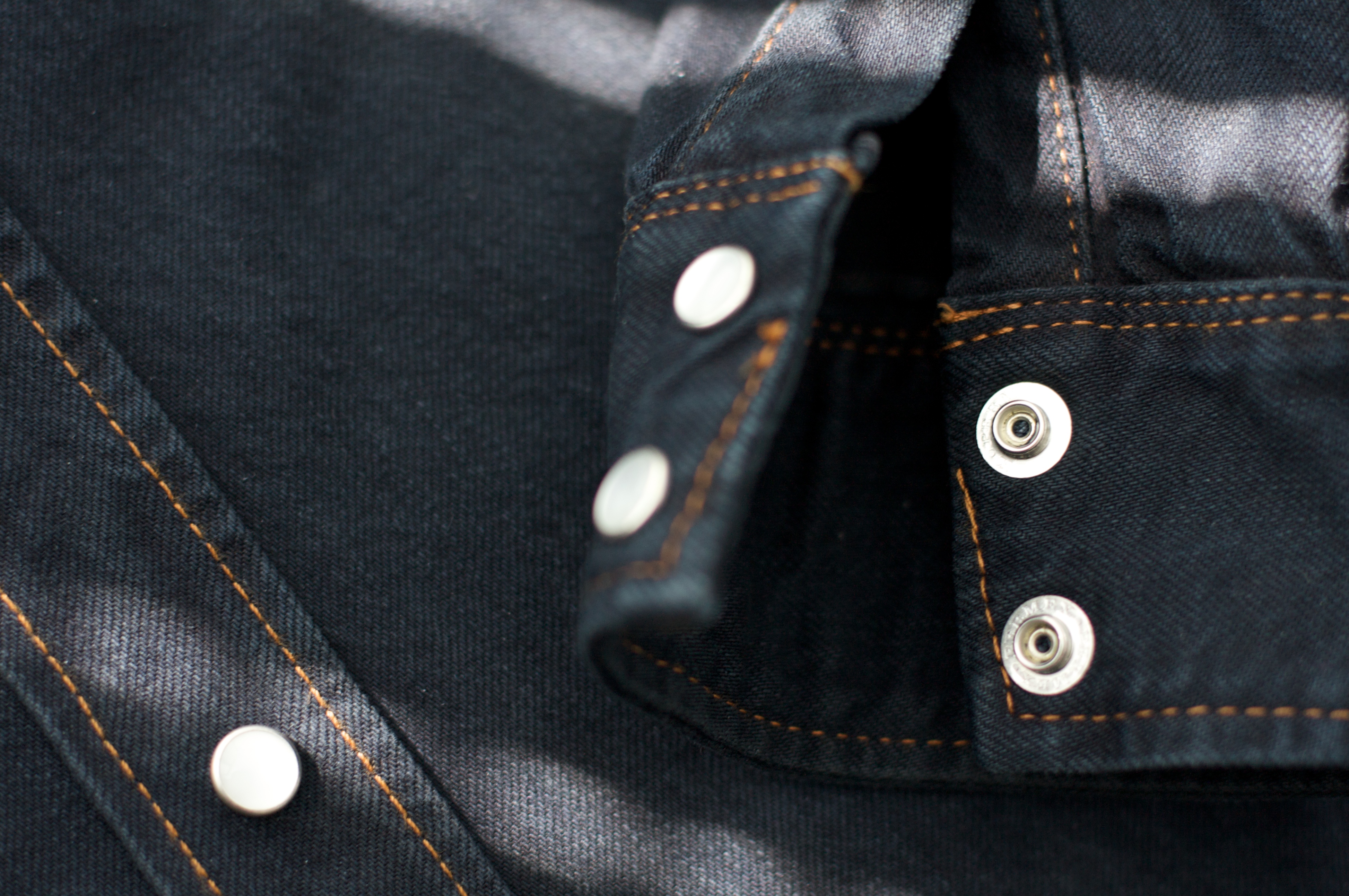
Western shirts are the layer that carries pattern. Jack Weil put the first snap fasteners on a cowboy shirt at Rockmount Ranch Wear in Denver in 1946. The checklist he set still holds: pearl snaps, sawtooth or smile pockets, shotgun cuffs closing with five snaps. On older shirts the smile pockets carry embroidered arrows, with piping down the collar and yokes. Worn open over a tee it does the work of a light jacket. Buttoned and tucked it reads formal enough for dinner.

Varsity jackets are the loud piece, and only one loud piece goes on at a time. The Harvard baseball team sewed an H onto heavy wool sweaters in 1865 and the football team copied it ten years later. By the 1930s that had become a melton wool body with leather sleeves, banded collar, ribbed cuffs and waistband in school colours, and a chenille letter above the left breast. The cut stops at the hip. It wants a high-rise trouser under it.
Chore coats and flannel are the quiet layer. A chore coat is cotton duck or moleskin, three patch pockets, blanket lining if it was cut for winter. Flannel is shirt weight brushed on both faces. The vintage ones run heavier than anything sold new under the name.
Military surplus brings the one true neutral in this wardrobe: olive drab. Field and flight jackets came out of government contracts and carry contract numbers and specification stamps printed inside, making them the easiest category to date and the hardest to fake.

Souvenir tees are the base layer that stops an outfit looking assembled. National parks, roadside attractions, bands, county fairs. The graphic dates the artwork and the hem stitch dates the shirt, and the two disagree more often than they agree.
Reading the Fades a Previous Owner Left
Old clothes come with something new ones do not, and it usually surfaces after the money has changed hands. Denim fades have names, and each name records a movement. Whiskers are the creases across the lap, earned by sitting down and standing up. Honeycombs are the overlapping creases in the hinge of the knee. Stacks form at the hem on uncuffed jeans, and train tracks run down the outseam where the selvedge line sits inside.

None of those were made by you. A forty-year-old pair carries the honeycombs of whoever bent their knee in them for a decade, at their knee height. Hold the jeans against your leg before buying: if the honeycombs land halfway down your calf, the last owner was taller, and those fades will keep reading as his. Fading down one shoulder of a shirt came from a hanger near a window.

Old denim does have advantages. The shrinking has finished, and the cloth is heavier than what shops sell now. Vintage 501s run about 14.75 ounces of rigid cotton. Modern pairs often carry two per cent elastane.
Decades of washing have already taken the cotton down. Vintage Levi's typically measure two to four inches smaller at the waist than a modern pair of the same marked size.
Alterations are the other half of it. An ordinary 1980s jacket or a common pair of mid-century jeans survives tailoring with its value intact. Doing the same to a documented archival piece destroys most of its value. The line runs between garments that are old and garments that count as evidence, and an 1880s pair with its original label sits on the second side of it.
Why the Sizes Make No Sense
Fibre content, country of origin and the registration number can all be taken at face value. The number on the size label is the exception. That goes back to a federal standard the government withdrew in 1983.
The National Bureau of Standards published Commercial Standard CS 215-58, Body Measurements for the Sizing of Women's Patterns and Apparel, in 1958. It rested on a 1939 Department of Agriculture survey that measured 14,698 women across seven states on 58 body points, and that excluded non-white measurements from the final statistics. The standard went voluntary in 1970 and was withdrawn in 1983, after which every American brand wrote its own chart.
Sizes have drifted about four numbers since. A 1960s dress marked 12 fits closer to a modern 4 or 6; a 1970s 12 lands near a modern 6 or 8; a 1995 12 is about a modern 10.
Menswear moved less. Tailors sold suits by chest and inseam. A 1970s 42 regular still sits close to a 42 regular today.
One decade reverses the drift. Nineties streetwear went loose on purpose, and a medium from that decade often measures like a modern large.
Why It Is Always Denim and White Tees
Nothing here was designed to be looked at, and that indifference is a large part of why so much of it survived. Levi's sold jeans through farm supply stores. The white crew-neck tee was underwear, worn under a shirt and not in public. Chore coats went to labourers, flannel to lumber crews, field jackets to soldiers, varsity jackets to athletes who had earned the letter. All of it was built to be worn out.
The Films That Made Workwear Fashion
Both outfits have been catalogued piece by piece, and the catalogues disagree with the popular version on several counts.

Marlon Brando, The Wild One, 1953. Johnny Strabler, leader of the Black Rebels Motorcycle Club, in a black steerhide Perfecto-style jacket with notched lapels, an asymmetric zip front, snapped epaulettes carrying a single star each, and a half-belt. His name is painted in cursive across the left chest. Under it, a ringer T-shirt with piping at the crew neck and sleeve ends. Colour photography from the production shows it in light beige, where every retelling makes it white. Below, dark indigo selvedge jeans with a button fly and self-cuffed plain hems, a black leather belt with X-lacing, and black bullhide engineer boots with buckled straps and double leather outsoles.
The jeans are only presumed to be Levi's 501s. That presumption rests on the button fly. The zip-fly 501Z arrived in 1954, a year after the film.

James Dean, Rebel Without a Cause, 1955. Nicholas Ray directing, Moss Mabry on costumes. The red windbreaker is a McGregor Anti Freeze, a late-1940s design that McGregor still acknowledges on its own site. Under it a white crew-neck tee. The jeans are Lee 101Z Riders in the standard five-pocket layout, identifiable by the small black tab stitched above the right back pocket. Black leather engineer boots again, the buckle on the throat strap visible, the shafts running ten to eighteen inches up the leg and never appearing on screen.
The film that did more than any other to sell Levi's has its lead in a pair of Lees.
Dean opens the picture in a black wool suit, a white collared shirt and a burgundy knit tie held with a pin, and arrives at the red jacket and the jeans by the end.

Brando's leather needed his particular physical presence to carry it. Dean traded it for a light zip jacket, kept everything else, and put the same silhouette within reach of a teenager who had never been near a motorcycle. Rebel Without a Cause opened on 27 October 1955; Dean had died in a car crash on 30 September, aged twenty-four.
What a Vintage Dealer Styled This January
For a dated case with the garments named, JAM Vintage published three head-to-toe sets on 29 January 2026.

Set one. A half-length military jacket over denim trousers, black leather boots, and a checked tailored jacket carrying the pattern.
Set two. A denim jacket over military trousers, a grey sweatshirt underneath, leather shoes and a corduroy cap.
Set three. A suede leather jacket with duck trousers and brown side-gore boots, every piece inside a brown-to-tan range.
Every set crosses two uniforms: military over denim, denim over military, duck trousers under suede. None of them wears one category head to toe. Mixing two uniforms keeps the outfit from reading as a costume of either one. The shop's own definition puts the roots in American workwear and military uniforms, reinterpreted with narrower silhouettes.
Set three is the one worth copying first. Holding everything inside a single colour range is the cheapest way to make mismatched decades look deliberate.
Buying the Same Look New in 2026
The Brando and Dean garments are all still in production. The current versions come with published specifications.

The jacket. A Carhartt Detroit, catalogue number J001, in 12-ounce ring-spun cotton duck with a blanket-lined body and quilted nylon through the sleeves. Corduroy top collar with under-collar snaps for an optional hood. A zippered left-chest pocket, two lower front pockets, two inside. Snap-adjustable cuffs, a pleated bi-swing back, triple-stitched main seams. Large regular runs 29 inches down the back. It sits at the waist.
The trousers. Straight or regular-cut denim in mid to dark indigo. A skinnier leg makes a chunky boot look outsized. That single proportion decides whether the outfit hangs together.

The boots. Red Wing Iron Rangers in the 8085 make-up, six inches, cap toe, Goodyear welted. Red Wing has been building boots in Minnesota since 1905, originally for ironworkers and farmers, and the welt means a pair can be resoled for decades.
Underneath, a tee or a henley. Over the top, nothing louder than a buffalo plaid overshirt. Linen trousers and shorts both fight the boots.
One rule runs against expectation. The less beaten-up the denim, the more relaxed the outfit reads, and heavy factory distressing achieves the opposite of what it aims at. Raw denim that has not been broken in reads as unworn, and a leather jacket kept too clean reads as costume. These garments were built to acquire a history, and a new one starts that history at zero.
Twenty Years Is Where the Line Sits
Dealers call a garment made twenty or more years ago vintage; anything newer is secondhand.
The twenty comes from the other end of the scale. The Tariff Act of 1930 wrote the hundred-year line for antiques into American law so that genuine antiques could enter duty free, and US Customs still applies it under heading 9706 of the tariff schedule. Nothing comparable exists for vintage. The trade settled on twenty to ninety-nine years as the band below the legal one.
That boundary advances every January. In 2026 it sits in 2006. Low-rise jeans, trucker hats and the first wave of fast fashion all qualify now.
Money holds the convention in place: a confirmed pre-1980 piece fetches more than the same garment listed only as vintage style.
Where the Manufacturing Date Is Recorded
All of that assumes the garment is old. Four marks settle it, and they take about half a minute to read.
Turn the thing inside out and start at the neck.
The care label. The Federal Trade Commission's care labelling rule, 16 CFR Part 423, requires manufacturers and importers to attach care labels where a customer can find them. It took effect in the early 1970s. A garment with no care label at all is probably older than that.
The hem stitching. A single line of stitching around the sleeve and bottom hems points to production before the mid-1990s, when double-needle machines became standard. On T-shirts the stitch decides the price bracket more reliably than anything printed on the front.
The RN number. The FTC issues registered identification numbers under 16 CFR 303.20. The system has run since the 1940s and the database now holds more than a hundred thousand entries. Numbers went out roughly in sequence. Low numbers indicate an older registration and high numbers a newer one. One catch: the number registers the company. Treat it as the earliest possible date.
A union label. An ILGWU or ACWA tag narrows the decade and confirms American manufacture.
Cross the four and the range tightens fast. No care label, a short RN, a union tag and a Made in USA line put a garment somewhere in the 1960s.
Four limits are worth naming before any of this gets used on an actual garment.

A copyright year on a graphic dates the artwork. Shirts kept printing the same design for years afterwards.
Missing care labels do not prove the 1950s, only that the garment predates the rule or was made outside its reach.
Made in USA persisted well past 1980 and continues in places today.
Single stitch was common outside America too. A single-stitch hem puts a garment before the mid-1990s and leaves the country open. The four marks get read as a set for that reason.
Levi's Pin Down the Year Better Than Anything Else
A pair of Levi's carries two marks that do most of the work. They have to be read together.

The red tab on the back pocket spelled LEVI'S in capitals until 1971 and Levi's in lower case after. Collectors call the earlier one Big E.
Selvedge is the second mark: a clean self-finished edge inside the outseam, woven on narrow shuttle looms, standard until the early 1980s. On many pairs that edge shows a red line.
Redline selvedge outlasted the tab change. A small-e pair with a red line is typically 1971 to 1986. Reading one mark without the other puts a pair [a decade too early](https://tumbleweedthrift.
Fakes give themselves away through internal contradiction. A Big E tab above a 1990s care label means the tab was moved; tags that look newer than the garment around them mean the distressing was deliberate.com/how-to-identify-vintage-levis/).
People Mean Two Different Things by Vintage Americana
Two people asked what vintage Americana looks like can give incompatible answers, and both are in wide use.
Vintage dealers mean actual garments: workwear, western, biker, souvenir tees, athletic basics, military surplus, running roughly from the 1950s to the 1980s, mostly menswear or unisex.
The other meaning is an internet aesthetic that formed in the early 2010s around an idealised 1950s: swing skirts, petticoats, gingham, cherry prints, heart-shaped sunglasses, diner uniforms. It is womenswear, mostly reproduction, and it takes its cues from music videos.
The first can be dated on the garment. The second formed around 2012. Most of the clothing in it was made after that. Formed around 2012, the aesthetic is itself too young to be vintage by the rule it borrowed the word from.
Japan Bought Up the Supply and Rebuilt the Looms
The largest single force in this market operates out of Osaka.
Japanese collectors began travelling to the United States in the 1970s and 1980s to buy old Levi's, and vintage shops at home turned American workwear into a category of its own. They bought the supply down. Genuine pre-1960s denim got scarce and expensive, and some of the buyers decided to make it instead.

Shigeharu Tagaki founded Studio D'Artisan in Osaka in 1979, on the grounds that Levi's, Lee and Wrangler had moved to high-speed projectile looms and sanforized cloth, losing the slub, the irregularity and the shrinkage that had defined the older jeans. He bought vintage Toyoda shuttle looms, running at roughly a quarter of the speed of modern machines, and built a supply chain around indigo dyers in Tokushima.
Four more followed in Osaka: Denime in 1988, Evisu in 1991, Full Count in 1992, Warehouse in 1995. The looms they hunted down had been sold off cheap when the Japanese mills modernised. A generation of machines built to weave narrow cloth sat idle in warehouses at exactly the moment a handful of people wanted narrow cloth again. It was not arranged. It is why the reproduction industry ended up in Osaka. The American mills had scrapped theirs. Collectors call them the Osaka Five, and their jeans now sell around 250 to 330 dollars a pair.
All five started after the American mills stopped weaving the cloth in the 1980s.
Vintage, Repro and Retro Are Not the Same
Vintage-styled clothing is new production cut and washed to look old, and it is the great majority of what sells under the word.
Reproduction is new production copying a specific historic garment as closely as the maker can manage, down to loom width and thread count, sold openly as a copy. Levi's Vintage Clothing is the best-known example.
Retro borrows a period's shapes and colours without copying any particular garment. Since it claims nothing about age, the care label and the RN and the stitch have nothing to confirm.
What Old American Clothing Costs
What a garment costs tracks how well its age can be demonstrated. At the extreme, documented nineteenth-century denim reaches six figures: seven pairs of 1800s jeans came out of a single Arizona mineshaft in 2020, and the 2018 record for a pair of 1893 Levi's stood near 100,000 dollars.
Below that sits a 1970s pair with single stitch, redline selvedge and the original buttons, trading in the hundreds. The same pair moves at very different numbers depending on who has looked at it. A sorted resale shop prices a 1972 501 XX around 120 dollars; a thrift store that sorts nothing by date might put it at ten. Ordinary 1980s and 1990s pieces qualify on age and stay cheap on supply.
At the bottom is vintage-styled new production, priced at whatever the brand charges. Everything on it was made this season. The price is whatever the brand decides. In practice that runs from twenty dollars to two hundred.
Common Questions
The garments have to be American in origin. Where they end up is another matter: one 1880s pair of 501s sold to a Japanese buyer for 60,000 dollars.
Assume an estimate. Check the care label, the hem stitching and the RN before you accept a decade.
Yes, and so is most of the early 2000s. By the twenty-year convention, a 1995 tee crossed the line in 2015.
Only if you measure. One extra check for denim. Vintage rises run high; a pair that fits your waist can still sit four inches above where you expect.